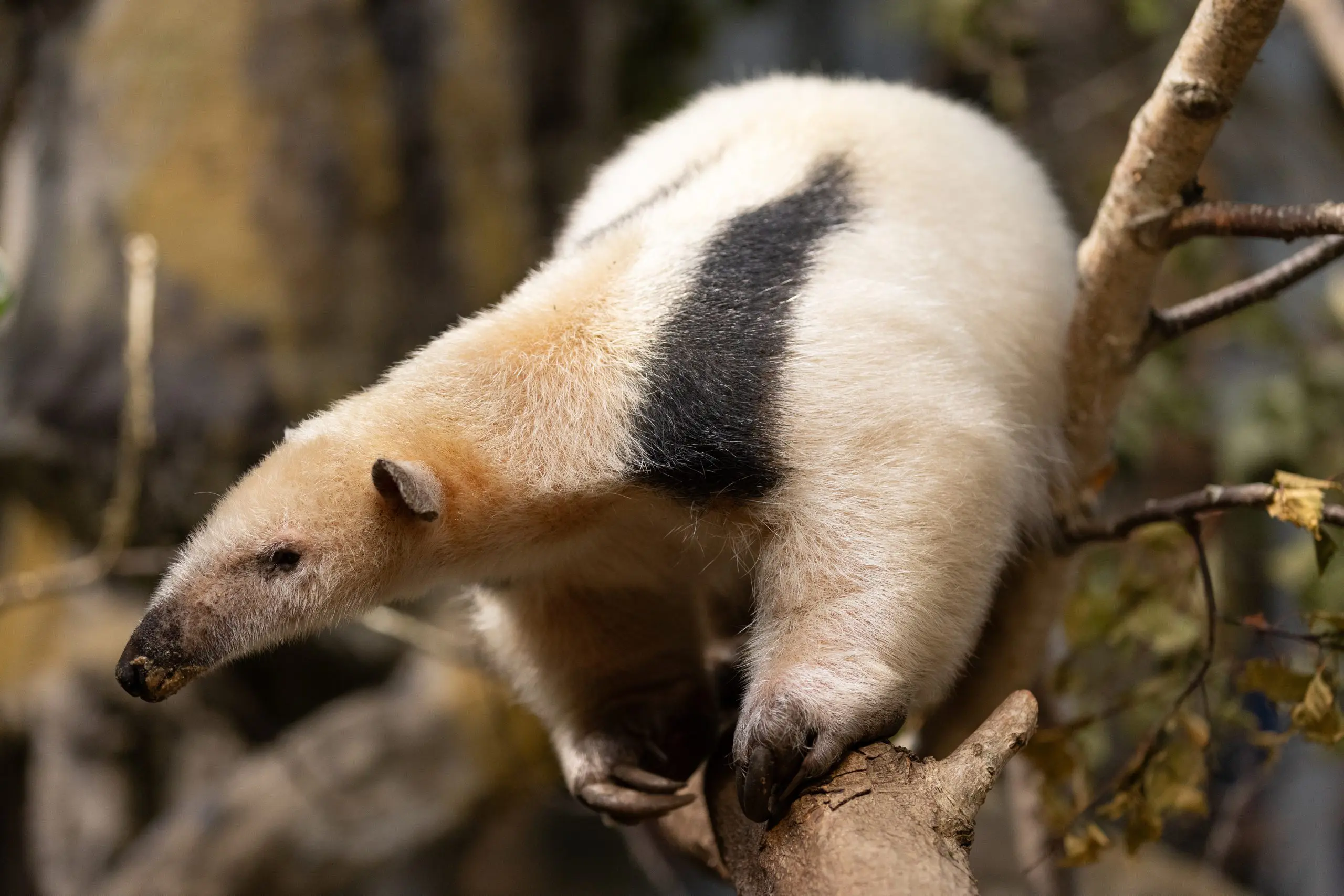
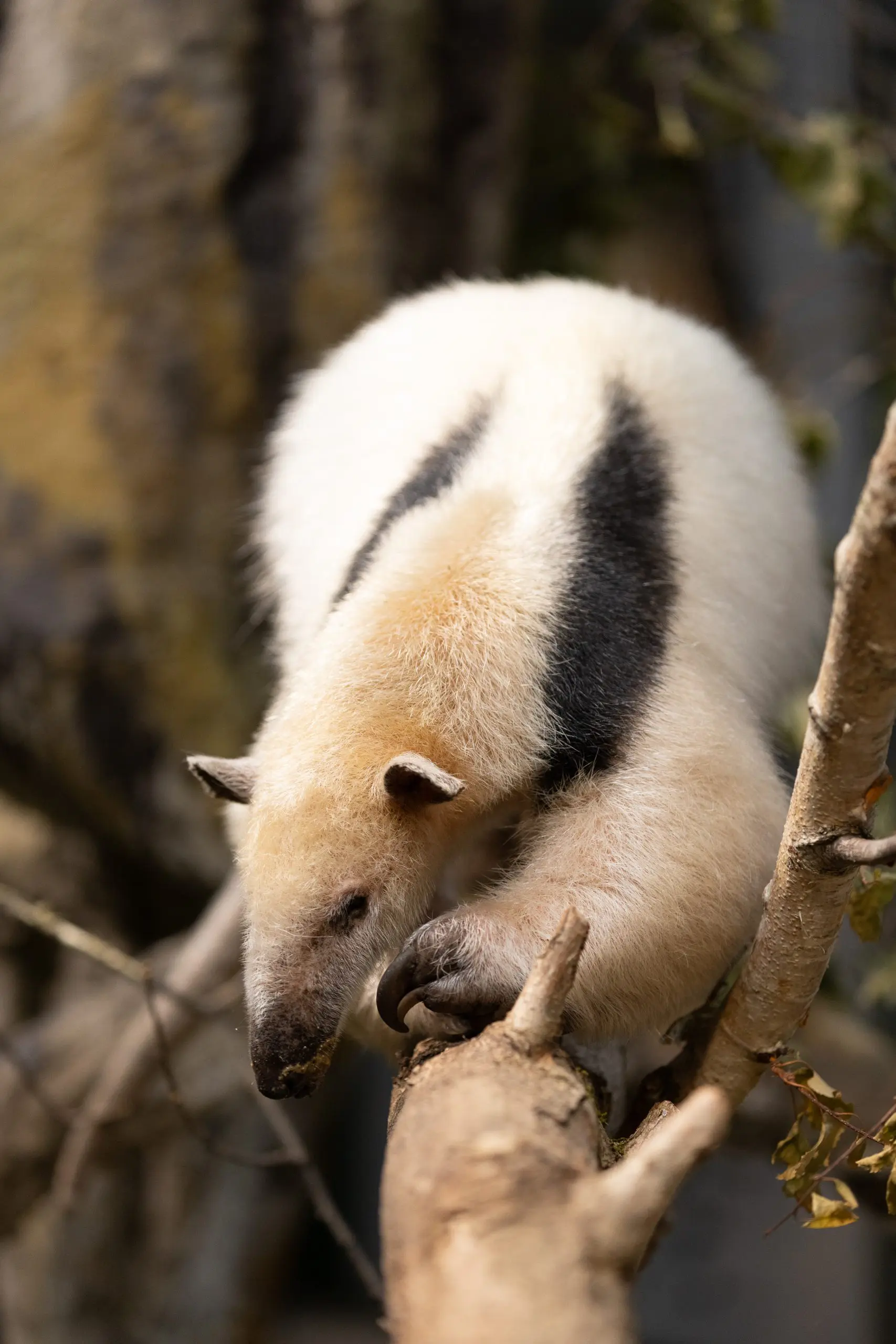
Southern tamandua
The southern tamandua is a species of anteater from South America and the Caribbean island of Trinidad
Species
Mammals
Habitat
Rainforest
Diet
Insectivore
Conservation Status
Least Concern
Southern tamandua
Tamandua tetradactyla
Irish Name: Tamandua deisceartach
IUCN Status: Least Concern
Southern tamanduas are primarily nocturnal but have also been known to be active during the day.
They are largely solitary animals, though have been known to thrive in pairs when in human care. They nest in the hollows of trees or the burrows of other animals such as armadillos.
When threatened, a southern tamandua will hiss and release an unpleasant smell from a gland beneath the base of its tail. If in a tree, they will grasp onto branches with their tail and hind limbs to leave their front claws free for use.
Most of a southern tamandua’s day is spent foraging for food.
Though quite adept in trees, on the ground they are known to amble along rather clumsily. Unlike giant anteaters, they are unable to gallop.
General Information
Zoo location
The southern tamandua can be found in the Rainforest House at Dublin Zoo
Animal class
Mammalia
Animal order
Pilosa
Where do they live (Natural habitat)?
Southern tamanduas are highly adaptable in terms of their habitat preferences. Across South America, they have been found in both wet and dry forests, tropical rainforest, savanna, and scrubland. However, they appear to show preference to habitats near rivers and streams, possibly due to prey abundance.
How long do they live?
Southern tamanduas have an average lifespan of around 9 years.
What do they eat?
Like all anteaters, as the name suggests, southern tamanduas primarily feed on ants and termites in roughly equal measure. An adult tamandua may consume up to 9,000 insects a day. They will actively avoid ants and termites with chemical defences, such as leafcutter ants. Tamanduas have also been known to feed on beetle larvae, bees, honey, and small portions of fruit.
Group name
Due to their relatively solitary lifestyle, there is no specific collective name for southern tamanduas. A group of southern tamanduas may be referred to as a ‘colony’.
Closest related species / sister species
The southern tamandua is most closely related to its fellow tamandua, the northern tamandua (T. mexicana). They are also quite closely related to other anteater species such as the giant anteater, and are in the same order as sloths, known as ‘Pilosa’.
Fun Facts!
Southern tamandua
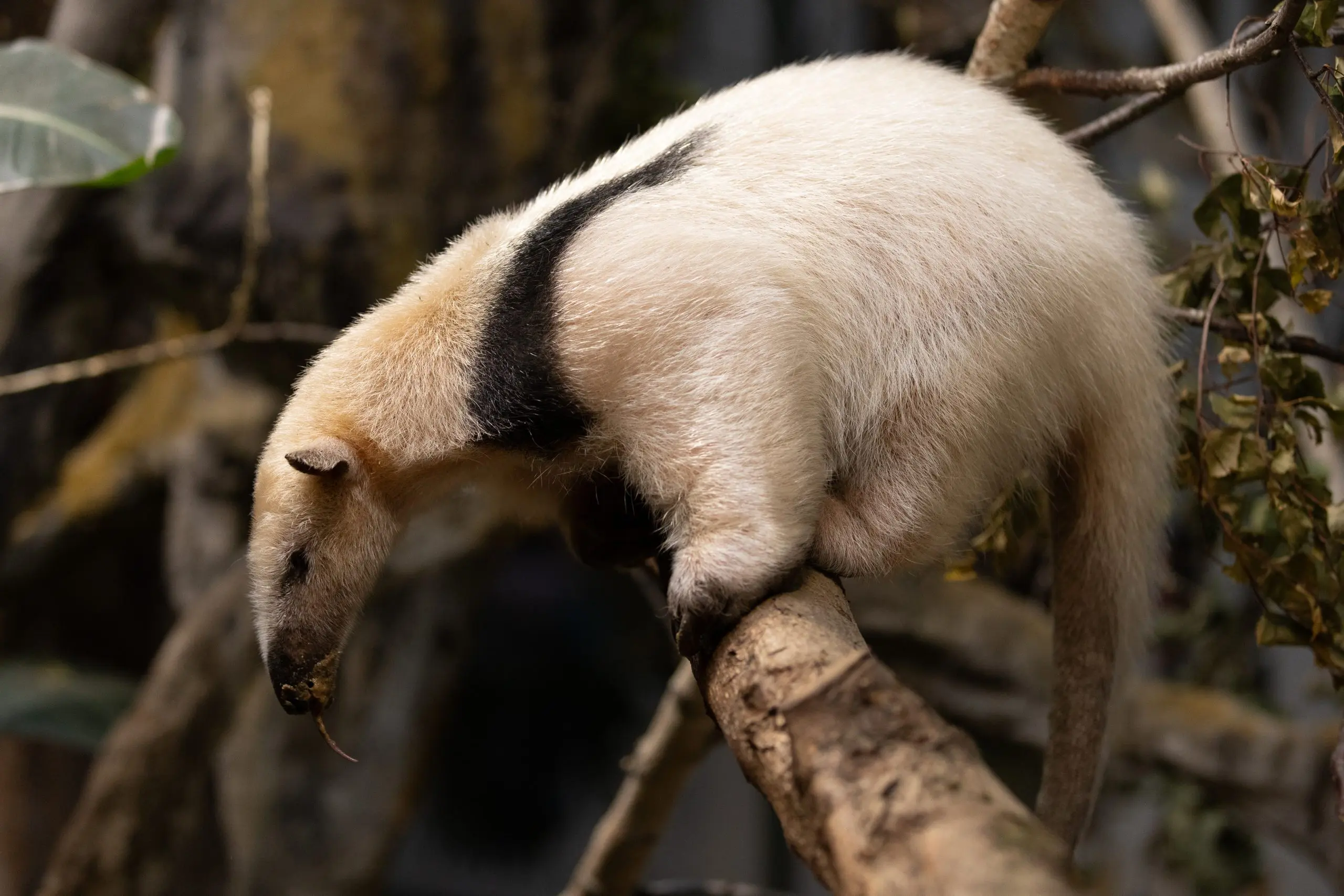
Behaviours
Southern tamanduas are primarily nocturnal but have also been known to be active during the day.
They are largely solitary animals, though have been known to thrive in pairs when in human care. They nest in the hollows of trees or the burrows of other animals such as armadillos.
When threatened, a southern tamandua will hiss and release an unpleasant smell from a gland beneath the base of its tail. If in a tree, they will grasp onto branches with their tail and hind limbs to leave their front claws free for use.
Most of a southern tamandua’s day is spent foraging for food.
Though quite adept in trees, on the ground they are known to amble along rather clumsily. Unlike giant anteaters, they are unable to gallop.
Reproduction and Life Cycle
Southern tamanduas have a period of 42 days in the Autumn during which to mate, as this is when the females are in oestrous.
Pregnancy can last for between 130 and 190 days, after which a single offspring is born. The infant will cling onto the mother’s back for the first few months of its life, sometimes up to a year, though the mother may occasionally deposit the infant on a safe branch temporarily while she goes to forage nearby.
After this first year, the tamandua has reached maturity and will go off on its own. Southern tamanduas have an average lifespan of around 9 years.
Adaptations
Like all anteaters, southern tamanduas have a long sticky tongue for gathering insects to feed on. This tongue can be up to 40 centimetres in length. They also have long, sharp claws that can be used to break into the nests of ants and termites.
Southern tamanduas have a long prehensile tail, allowing them to use it as a fifth ‘limb’ for grasping onto branches to keep their forelimbs free for foraging and defence up in the trees.
Though they have rather poor vision, their large, upright ears given them a keen sense of hearing.
To keep their front claws sharp and prevent them from poking their palms, southern tamanduas walk on the outside of their hands rather than their palm or their knuckles like the giant anteaters.
Conservation
Least Concern
Southern tamanduas are listed as ‘Least Concern’ on the IUCN Red List of Endangered Species, due to their wide distribution and adaptability regarding habitat preferences.
Population
However, there are currently no solid estimates on their population size.
Threats
Southern tamanduas are also still impacted by hunting by feral dogs, habitat loss, disease, the illegal pet trade, and expanding human developments, particularly roads.
Frequently Asked Questions
Southern tamanduas are found on the Caribbean island of Trinidad and across South America in multiple types of habitats.
Southern tamanduas typically live for around 9 years.
Like other anteaters, southern tamanduas largely feed on ants and termites. They have also been known to feed on beetle larvae, bees, honey, and fruit.
Southern tamanduas are not listed as an endangered species. However, they are still impacted by human activities which lead to habitat loss, the spread of disease, and also the illegal pet trade.
outhern tamanduas can vary greatly in size, from around 70 centimetres to over 1.5 metres in length from the tip of their snout to the end of their tail.
Our southern tamandua, Valentine, can be found in the Rainforest House at Dublin Zoo alongside several monkey species, sloths, leafcutter ants, poison dart frogs and more.
Dublin Zoo is also home to a pair of giant anteaters, which can be found near the Flamingo Lagoon and not too far from Sea Lion Cove.