Red-footed tortoise
The red-footed tortoise is indigenous to northern South America
Species
Reptiles
Habitat
Forest
Diet
Herbivore
Conservation Status
Still to be evaluated
Red-footed tortoise
Chelonoidis carbonarius
Irish Name: Toirtís chosdearg
ICUN Status: Not Evaluated
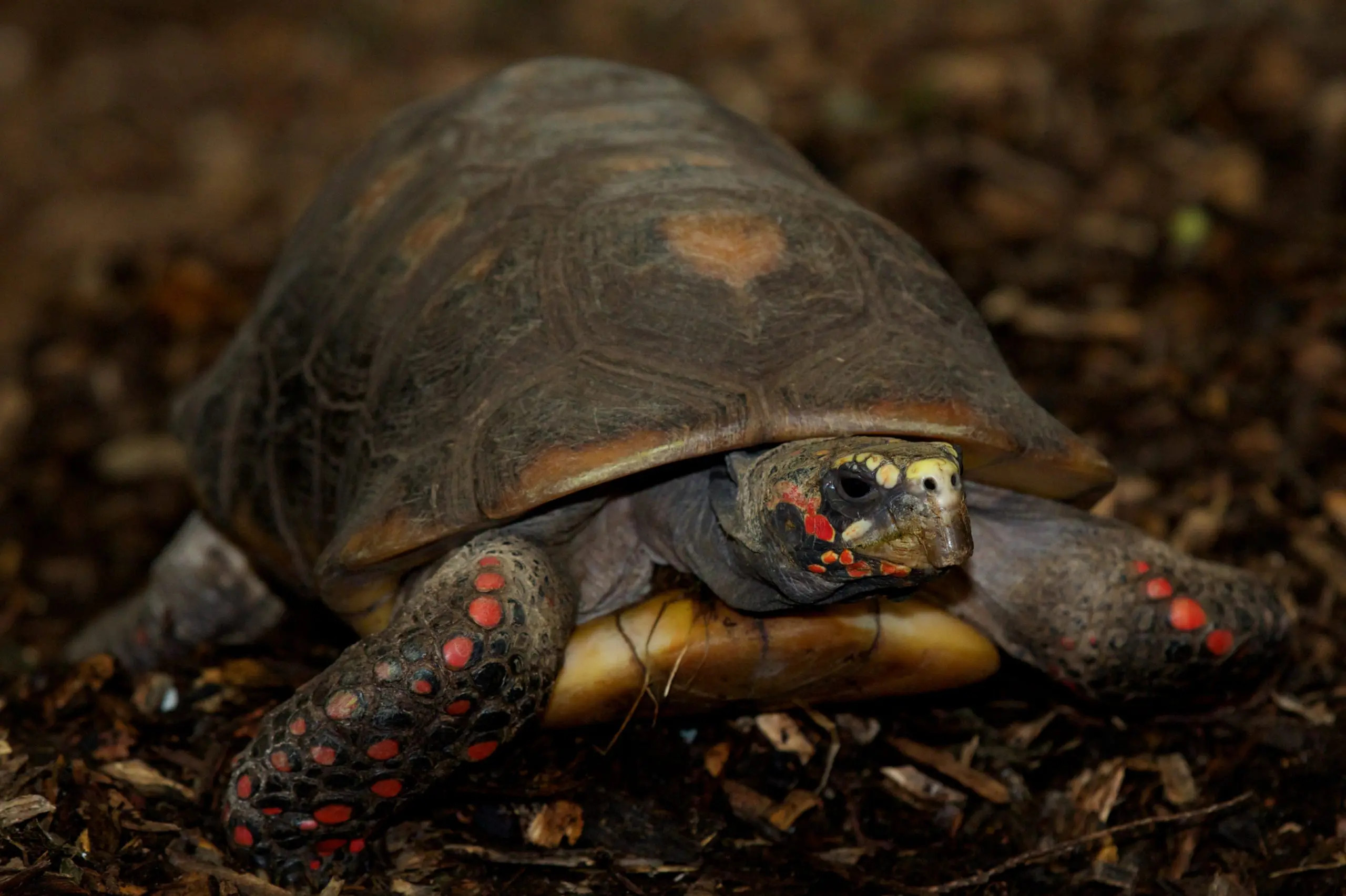
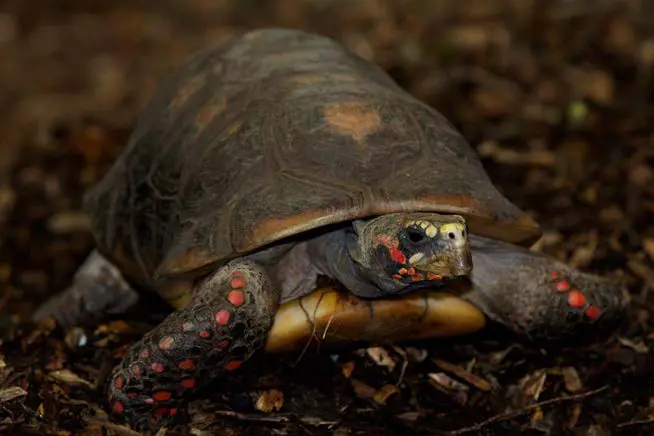
The red-footed tortoise is indigenous to northern South America. They are medium-sized tortoises with black/brown skin and a dark black, brown or grey shell. These tortoises are highly identifiable due to the brightly coloured scales on their limbs. These colours vary from yellows to oranges to reds. This unique colour pattern gives the red-footed tortoise its name.
General Information
Zoo location
South American House. They share their habitat with the white-faced saki. This is called a mixed-species habitat and allows our animals to further express their natural behaviour, as they may come across each other in the wild.
Animal class
Reptilia
Animal order
Testudines
Where do they live (Natural habitat)?
These tortoises are highly distributed among a variety of countries in northern South America. In the wild they can be found from Panama to Argentina, and on the Caribbean islands of Trinidad to Barbados. They can be found in dry and wet forested areas, savannahs and grasslands habitats.
How long do they live?
Red-footed tortoises can live upwards of 50 years. They have been known to live up to 70 years under human care.
What do they eat?
Red-footed tortoises have a mostly herbivorous diet. They have a diet high in fibre and eat mostly grasses, leaves, flowers, roots and shoots from a variety of green and flowering plants. Red-footed tortoises will each fruit from cacti and some fungi as well. Through faeces sampling of wild red-footed tortoises, they have discovered that these animals also eat small amounts of animal matter. They will eat invertebrates (insects) and carrion, which is decaying animal matter.
Group name
Like most other tortoises, it is very common for red-footed tortoise to live a solitary life and to come together as a breeding pair during the mating season. However, a group of tortoises is called a creep.
Closest related species / sister species
They are closely related to the other members of their genus, including the yellow-footed tortoise, the chaco-tortoise and Galapagos tortoises.
Fun Facts!
The Red-footed tortoise
Family life
The mating season usually begins during times of higher levels of rain. This occurs between April and May. Scent cues and courtship noises usually attract a male and female to each other for mating. This species of tortoise uses the bright yellow, orange and red colours on their limbs to identify that they have located the correct species. The female will begin nesting 5 – 6 weeks after mating. She will lay her 5- 15 eggs in leaf litter on the forest floor. The hatching of the tortoise eggs is dependent on the temperature of the environment. However, this process usually takes 150 days on average.
Baby name
Hatchling
Gestation (pregnancy) period
Incubation time for eggs takes 150 days
Number of young at birth
Mothers can lay between 5-15 eggs at a time.
Weight at birth
50 g
Age at maturity
Red-footed tortoises usually reach maturity at 5 years.
Adult size
Females can measure on average 28 cm in length and males 34 cm in length. Red-footed tortoises can weigh up to 9 kg. Males will have a concave shape and females will have a flat and level shell underneath.
Conservation
Not Evaluated
The Red-footed tortoise has not yet been evaluated by IUCN
Current population estimate
Due to the difficult nature of surveying populations of tortoise, and especially the red-footed tortoise that has a large distribution in the wild, there is no current documented estimate of population numbers. Due to the increased pressure of human-caused threats to their habitat, it can be hypothesised that the population is in decline.
Threats
Red-footed tortoises are mostly impacted by human activities such as urbanisation, habitat destruction and hunting.
What is Dublin Zoo doing?
Since 2003, Dublin Zoo has successfully bred a number of red-footed tortoises. These tortoises are still present in the larger European population of red-footed tortoises and are contributing to successful breeding programmes. Having this species at Dublin Zoo also promotes education surrounding the conservation of the red-footed tortoise and some of the threats it may face in the wild.