Green tree python
The green tree python is a bright green nonvenomous snake
Species
Reptiles
Habitat
Forest
Diet
Carnivores
Conservation Status
Least Concern
Green tree python
Morelia viridis
Irish Name: Glasphíotón crainn
ICUN Status: Least concern
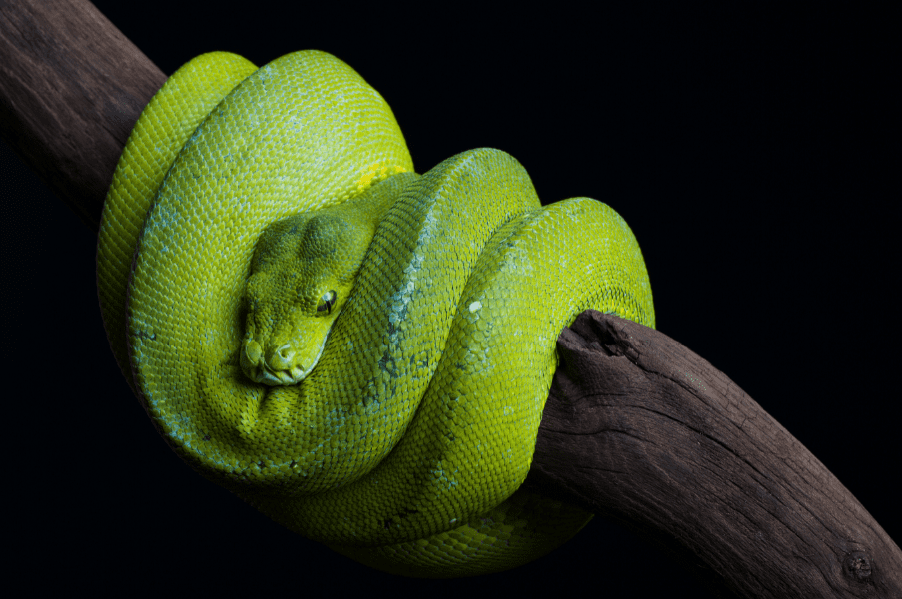
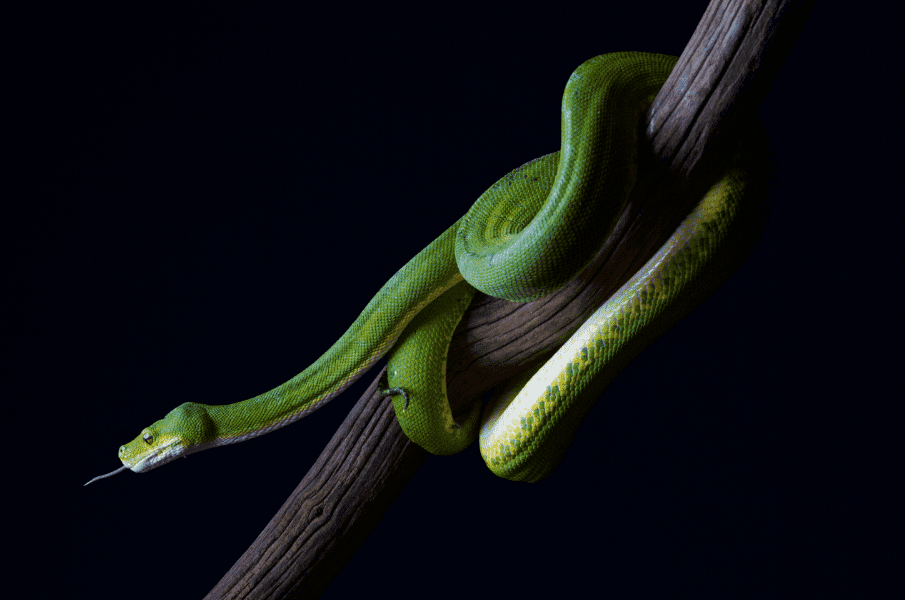
The green tree python is a bright green nonvenomous snake. They have a slender body, sometimes with small markings, and a yellow underbelly. Their tail is prehensile (can grasp), which helps them climb and catch prey. They spend most of their time in trees and can often be seen looped around branches.
General Information
Zoo location
Zoorassic World
Animal class
Reptilia
Animal order
Squamata
Where do they live (Natural habitat)?
Green tree pythons are found in tropical forests in New Guinea, eastern Indonesia, and the Cape York Peninsula of Queensland Australia. They are arboreal (spend most of their time in trees), but also come down to the ground, particularly at night.
How long do they live?
They live 15-20 years
What do they eat?
Green tree pythons eat small mammals and reptiles
Group name
They are normally solitary animals, so do not have a group name.
Closest related species / sister species
The green tree python is most closely related to other members of the Morelia genus including the rough-scaled python and southern carpet python.
Fun Facts!
The Green tree python
Family life
Green tree pythons are solitary, and only come together to breed. They breed during late autumn and winter. The females lays up to 32 eggs often in the hollow of a tree, and coils around the eggs to incubate them until they hatch. Hatchlings range in colour from bright yellow to brick-red; they don’t turn green until maturity.
Baby name
Hatchling
Gestation (pregnancy) period
Approximately 52 days
Number of young at birth
They lay between 6-32 eggs
Weight at birth
90-140 g
Age at maturity
2-3 years
Adult size
1.5 – 2 m in length and 1.1-1.5 kg in weight. Females are slightly larger and heavier than males.
Conservation
Least Concern
The green tree python is classified as of Least Concern by the International Union for Conservation of Nature.
Current population estimate
There hasn’t been an in-depth survey to determine the population.
Threats
The main threat facing green tree pythons is capture and collection for the pet trade.
Frequently Asked Questions
Green tree pythons are found in tropical forests in New Guinea, eastern Indonesia, and the Cape York Peninsula of Queensland Australia. They are arboreal (spend most of their time in trees), but also come down to the ground, particularly at night.
Green tree pythons eat small mammals and reptiles.
They lay between 6-32 eggs.
They grow from 1.5-2 m long.
They live 15-20 years.
Green tree pythons are nonvenomous. They are constrictors and ambush predators – they capture prey by using their tail to hold onto a branch and then striking out and constricting their prey.
Green tree pythons are classified as of Least Concern by the IUCN, meaning they are not currently endangered.