Chinese stripe-necked turtle
Also called the golden thread turtle
Species
Reptiles
Habitat
Wetlands
Diet
Omnivores
Conservation Status
Critically Endangered
Chinese stripe-necked turtle
Mauremys sinensis
Irish Name: Turtar píbstríocach Síneach
ICUN Status: Critically Endangered
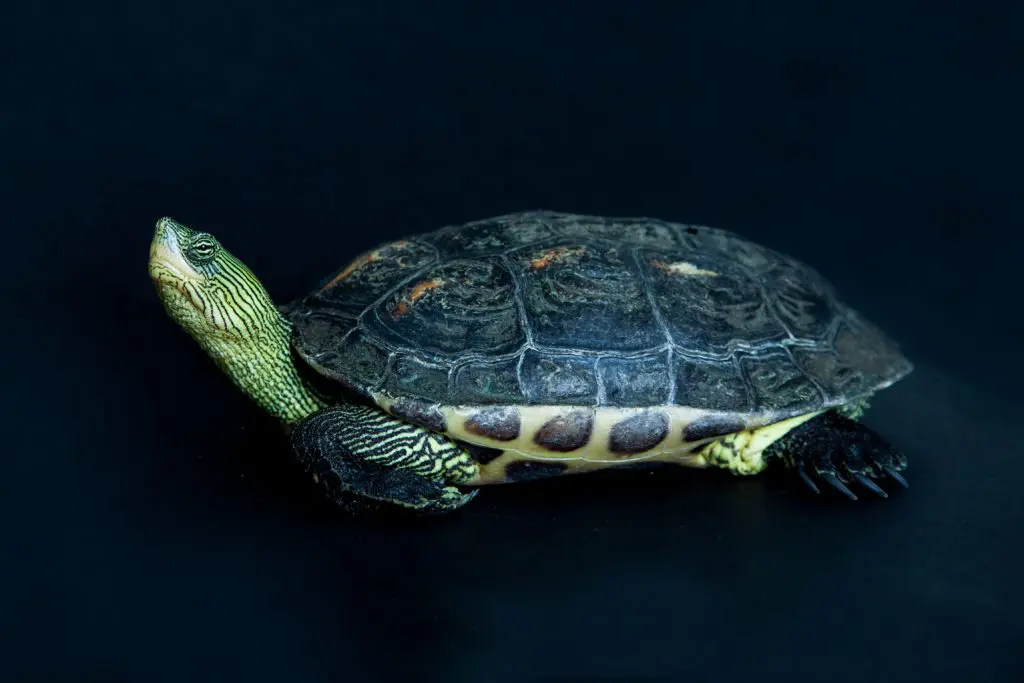
Chinese stripe-necked turtle (also called the golden thread turtle) have a green body and a brownish-grey shell. Their underneath, or plastron, is an ivory shade with black spots. Chinese stripe-necked turtles are named after the yellow, vertical stripes down its face and neck. These turtles prefer a habitat close to streams, ponds and slow-moving rivers. They have webbed feet and strong leg muscles which allows them to be powerful swimmers.
General Information
Zoo location
The Chinese stripe-necked turtle habitat can be found in Zoorassic World, beside the royal pythons.
Animal class
Reptilia
Animal order
Testudines
Where do they live (Natural habitat)?
These turtles can be found in Asia in countries such as China, Taiwan and Vietnam.
How long do they live?
Chinese stripe-necked turtles can live to 20 years of age.
What do they eat?
As hatchlings, Chinese stripe-necked turtles are omnivores. When females grow up, they adopt a herbivorous diet and eat plants high in fibre. They usually eat grass, green plants, flowers and moss. Males stay omnivores but tend to eat more meat than plants. Males mostly eat small insects and their larvae.
Group name
These turtles are solitary in nature and have no formal group name.
Closest related species / sister species
Their closest related species is the Japanese pond turtle.
Fun Facts!
The Chinese stripe-necked turtle
Family life
Very little is known about the breeding behaviour of this species in the wild. Like many other turtle species, the Chinese stripe-necked turtle is a solitary animal and has very little involvement with hatchlings once their eggs have been laid. However, Chinese stripe-necked turtles have been documented to bask in the sun, in relatively close proximity to other turtles of the same species.
Baby name
Hatchling
Gestation (pregnancy) period
Hatchlings emerge after 60-150 days of incubation.
Number of young at birth
Females will lay 3-10 eggs at a time
Size in length at birth
Hatchlings can measure 30-35 mm long
Size
Fully grown adult Chinese stripe-necked turtles can measure 20-22 cm in length.
Conservation
Critically Endangered
The Chinese stripe turtle has been evaluated as Critically Endangered by the International Union for Conservation of Nature.
Current population estimate
Due to the difficult nature of surveying wild populations in their native habitat, there is no estimate on the population number of this species.
Threats
Chinese-stripe necked turtles are facing threats such as habitat loss due to poor water quality and industrial development on rivers.
What is Dublin Zoo doing?
Dublin Zoo promotes the conservation education of this species through the Discovery and Learning department.
Frequently Asked Questions
Any animals with a stripe pattern is very well adapted to camouflage into their environment, as the stripes blend in with the surrounding habitat at a distance. Sometimes an animal with a striped pattern can use this camouflage to their advantage when hunting their prey or hiding from a predator.
Chinese stripe-necked turtles, alongside many other species of turtle, live in aquatic habitats. Turtles have webbed feet to allow them to move and swim through the water.
Like many other turtles, the Chinese stripe-necked turtle shell is made of their fused bony ribs and covered in layer of keratin. Keratin is the same substance that makes up hair, fingernails and horns. Shells are sensitive despite how hard they are.
Tortoises have a heavier shell that is shaped like a dome, they are adapted for living on the land. Turtle’s shells are flatter and thinner and are adapted for swimming in a variety of water sources like the ocean, ponds and streams.
It has been documented that these turtles can travel from 5 – 245 metres in a day. This is called their home range.