Central American wood turtle
The Central American wood turtle species at Dublin Zoo
Species
Reptiles
Habitat
Tropical
Diet
Herbivores
Conservation Status
Still to be evaluated
Central American wood turtle
Rhinoclemmys pulcherrima
Irish Name: Turtar coille Lár-Mheiriceánach
ICUN Status: Not Evaluated
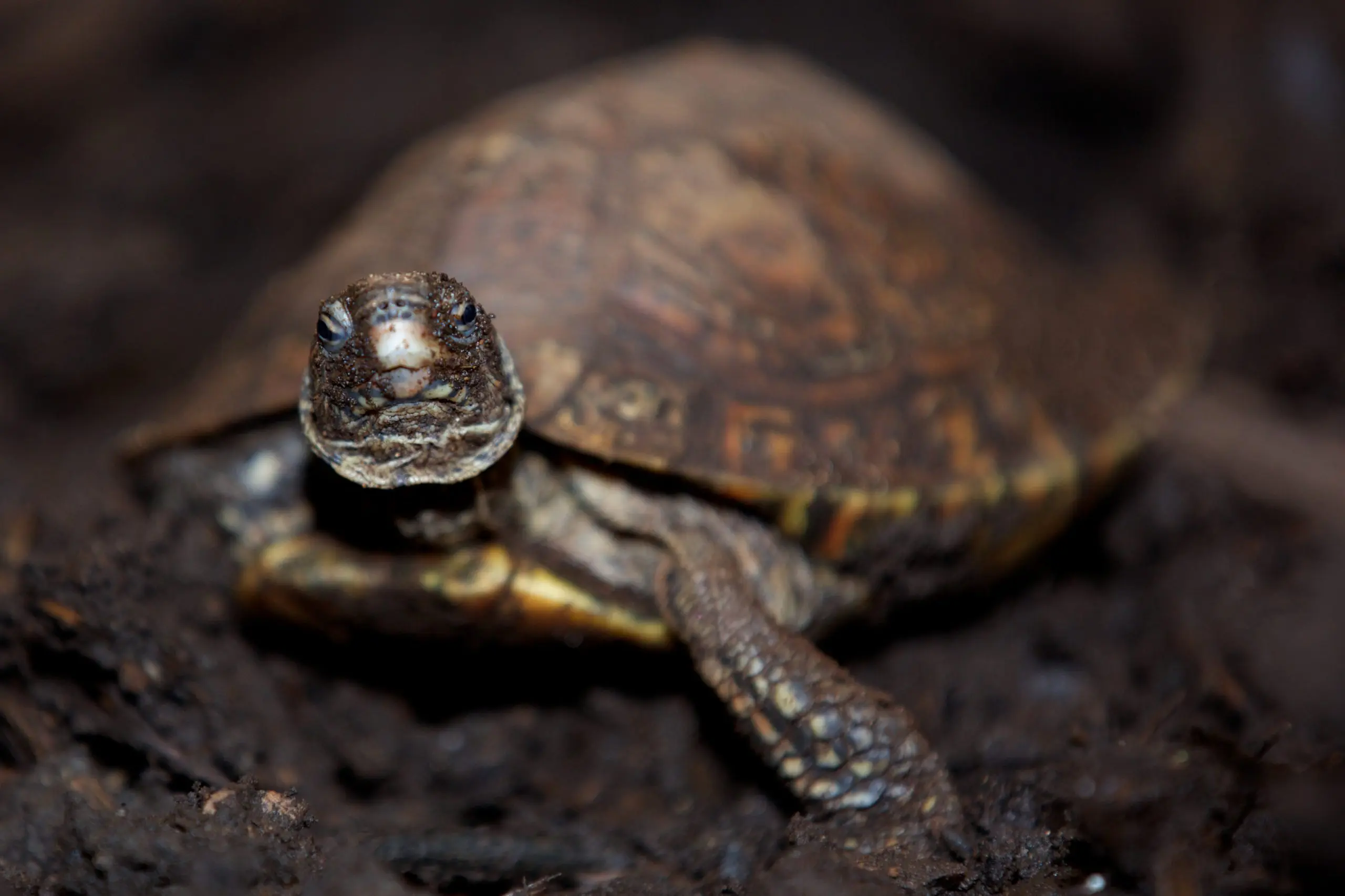
The principal colour of the Central American wood turtles’ body and shell is green. Individuals that are from Costa Rica will showcase bright colours, while Central American wood turtles from Nicaragua will be more subdued in colour. Some turtles have been documented to have yellow and orange swirls and different degrees of black eyespots on their shell. They could also have a bit of red or pink colouration on their head. As a result they have are also called ornate turtles or painted wood turtles. They are mostly terrestrial (living on land); they make their homes near rivers.
General Information
Zoo location
South American House
Animal class
Reptilia
Animal order
Testudines
Where do they live (Natural habitat)?
As their name suggests, they live in Central America: Mexico, Guatemala, El Salvador, Honduras, Nicaragua and Costa Rica.
How long do they live?
The lifespan of the Central American wood turtle in the wild is unknown but the oldest living Central American wood turtle in human care is 30 years old.
What do they eat?
These turtles will forage for food on land and in rivers and streams. They are mostly herbivorous (plant-eaters) and eat green plant matter, grass, flower and fruits. They have been known to eat animal matter sparingly and will forage for slugs, tadpoles and insects too.
Group name
Turtles do not form pair-bonds or social groups; they live in the wild as solitary animals until they come together for the breeding season.
Closest related species / sister species
The Maracaibo wood turtle is their closest relative. There are 4 species of painted wood turtle and a total of 8 wood turtle species within the Rhinoclemmys genus.
Fun Facts!
The Central American wood turtle
Family life
The breeding season for the Central American wood turtle is usually the summer months, which is June to October in Central America. Males will participate in breeding behaviour and bob their heads to try to attract the attention of the female. Wood turtles can mate on land or in water. The female will build a nest on a sandy bank near a river. Sometimes female turtles will urinate on the sand to prevent their nest from collapsing. Once the eggs have hatched, there is no parental involvement in raising the hatchings.
Baby name
Hatchling
Gestation (pregnancy) period
Eggs are laid after 30-50 days.
Number of young at birth
3-5 eggs are laid at a time.
Weight at birth
Hatchlings can weigh approximately 50 g
Age at maturity
Maturity in turtles is often a measure of size rather than time. Estimates of when these turtles reach maturity is when they reach a shell length of 12cm.
Adult size
Approximately 30-40 cm long body with a 45-55 cm long bushy tail. They weigh 2.3-2.7 kg.
Conservation
Not Evaluated
The Central American wood turtle does not yet have a IUCN Status
Current population estimate
Due to the difficult nature of surveying wild populations, the current distribution of the Central American wood turtle is unknown. The wild population of this species has not been evaluated by the International Union for Conservation of Nature.
Threats
These turtles are not currently known to be threatened, but other members of their genus have been declared Near Threatened by the IUCN due to a decline in numbers following habitat loss and destruction.
What is Dublin Zoo doing?
Dublin Zoo promotes the conservation education and awareness of this species through our Discovery and Learning department.
Frequently Asked Questions
Like many other turtles, the Central American wood turtle’s shell is made of their fused bony ribs and covered in a layer of keratin. Keratin is the same substance that makes up hair, fingernails and horns. Shells are sensitive despite how hard they are.
Tortoises have a heavier shell that is shaped like a dome, they are adapted for living on the land. Turtle’s shells are flatter and thinner and are adapted for swimming in a variety of water sources like the ocean, ponds and streams.
The most common way to tell if a turtle is a male or a female is to look at the length of its tail. Females tend to have shorter tails in comparison to males. Males will also have a concave plastron (underside) and females will have a flat plastron (underside).
This sound is not a vocalisation but a sound that is made when air is expelled from a turtles lungs. This sound is involuntary and is caused by the turtle moving its head back into its shell. It is hypothesised it is a defensive adaptation to predators.
Upwards of 0.32 kilometres per hour.