

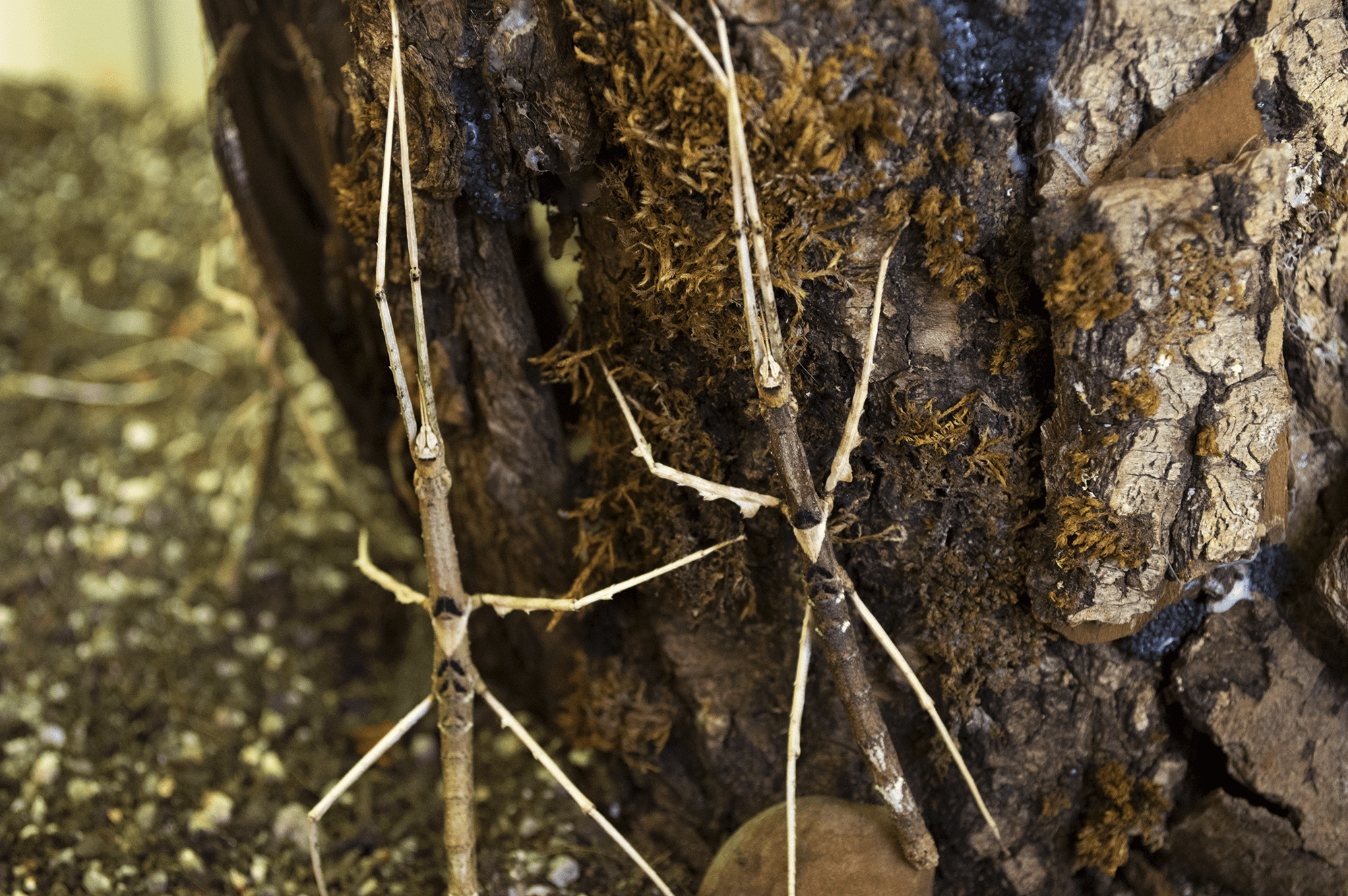
Zompro’s Thai stick insect
Species
Insecta
Habitat
Rainforest
Diet
Herbivore
Conservation Status
Still to be evaluated
Zompro’s Thai stick insect
Parapachymorpha zomproi
Irish Name: Cipíneach Téalannach Zompro
IUCN Status: Not listed
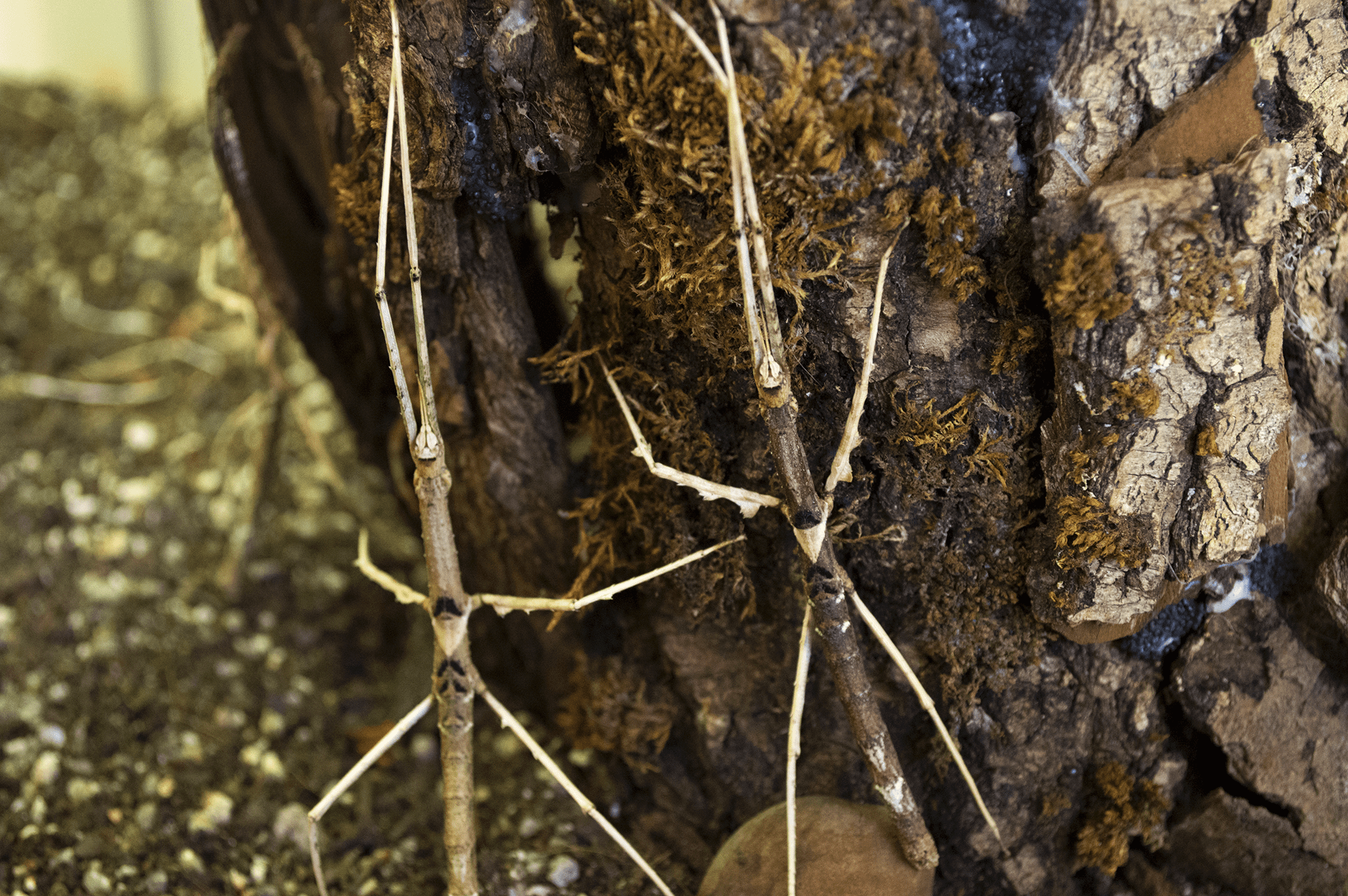
Zompro’s Thai stick insects have long brown bodies, reaching between 7 and 9 centimetres in length, with short white antennae and long white legs. Females are much more abundant and larger than males. The legs of males may also be darker in colour. They are found in the tropical forests of Thailand.

General Information
Zoo location
Discovery & Learning Centre
Animal class
Insecta
Animal order
Phasmatodea
Where do they live (Natural habitat)?
Zompro’s Thai stick insects live in the tropical and temperate forests of Thailand.
How long do they live?
They reach maturity between 6 and 8 months, and will live for approximately 18 months.
What do they eat?
The Zompro’s Thai stick insect is an herbivore, feeding mainly on leaves. At Dublin Zoo, they are fed a mixed diet of bramble and privet leaves, but will also feed on oak, ivy, and rose leaves.
Group name
The collective name for a group of stick insects is a ‘bushel’.
Closest related species / sister species
Zompro’s Thai stick insects are most closely related to other stick insects in the family Phasmatidae, which includes the longest species of stick insect discovered so far.
Fun Facts!
The Zompro’s Thai stick insect
Behaviours
Zompro’s Thai stick insects are primarily nocturnal. During the day, they remain very still to avoid detection by predators.
Reproduction and Life Cycle
Zompro’s Thai stick insects can reproduce both sexually and asexually. As females are much more abundant than males, it can be difficult to find a mate to breed with. Thus, the females have evolved the ability to self-fertilise and produce eggs. This asexual reproduction process process is known as ‘parthenogenesis’. As the eggs are self-fertilised, all the nymphs that hatch are also female. Genetically, they are exact clones of the female who laid their egg.
The eggs will incubate in the soil for between 3 and 4 months before the nymph hatches. They reach maturity between 6 and 8 months, and will live for approximately 18 months. Throughout their lives, the insects will moult several times. This is because their outer bodies, known as an exoskeleton, is made of chitin, a tough protein that does not grow with them. As a result, they must shed their old skin whenever they grow. Most stick insects go through 6 to 8 moults in their lifetime.
Adaptations
The body of a Zompro’s Thai stick insect has evolved to resemble a small twig, allowing it to easily camouflage in amongst trees and leaf litter to avoid predation.
Their eggs resemble seeds which are collected by ants. The eggs hatch safely in the ant nest, and the nymphs leave as soon as possible, climbing into the nearest tree for safety.
Conservation
Not Listed
The Zompro’s Thai stick insect is not listed on the IUCN Red List of Endangered Species. This is likely a result of its wide distribution and abundance, as well as popularity in the pet trade.
Frequently Asked Questions
Zompro’s Thai stick insects are found in the tropical and temperate forests of Thailand.
They are herbivores. In human care, they happily feed on privet, bramble, oak, and ivy leaves.
In the earliest stage of their lives, stick insects are referred to as ‘nymphs’.
Parthenogenesis is the process by which a female animal can reproduce asexually (without a mate) by fertilising their own eggs to produce offspring. These offspring are genetically identical to their mother, technically making them clones.
The stick insects can be found in the Discovery & Learning Centre at Dublin Zoo.